
The first month of 2026 has seen no shortage of intrigue. Many are publishing year end outlooks, expectations, price targets, and prognostications, which by and large are all interesting. Michael Howell (Capital Wars) and Craig Shapiro (The Alethea Narrative) remain at the top of my current list of those individuals who I believe “get it.”
Given my macro orientation and long/short protection focus, I am going to focus my prognostications on the various hotspots and thematic plays that I expect will generate outsized market focus at times throughout 2026… but I’ll do that at the end of this update.
Because, quite frankly, the first 30 calendar days of this year have seen more convexity, volatility, exhaustions, and “six sigma” moves that I can remember in my 25+ years of following the markets – which includes 2008 and the COVID crash. There are any number of reasons for this, but to me, there are two overarching themes – one I’ve harped on for years, the other I’ve worried about for years but I believe is finally solidified into the investing mainstream.
Firstly, market and societal structure have increasingly tilted in nearly all ways towards higher volatility. This is not just 0DTEs and 2x/3x levered ETFs, but it’s evident across society – notice the dramatic uptick in online gambling across sports, political elections, and potential newsworthy “events.” Seemingly everything now has instant gratification, odds and/or payouts with all or none outcomes – in many ways just like 0DTEs and levered ETFs.
For professionals who have been in markets for decades, these changes in market structure and increased number of investment vehicles offer incredible asymmetric opportunities when they present themselves, where one can put down a finite amount of capital and generate outsized returns without taking material gap or idiosyncratic risk. Non-professional investors, meanwhile, might fall into more dangerous traps. Many investors looked at a simplistic silver chart two weeks ago when it was trading at $100 or $105, noticed it was going asymptotic, and posted in a chat “Silver monthly RSI is above 95, that’s never happened before! Time to buy puts and ZSL!” Those “investment philosophies” may have appeared historically probable at a 98%+ likelihood, and they were right – but if you were in a 3x levered fund or 0DTE puts and you mistimed your investment, you may have been right about the ultimate direction (after Friday’s ~40% decline) and yet still lost a significant amount of money. Not surprisingly, I unfortunately saw a number of posts on X to that effect over the past few days.
But that’s what the casino wants. And that’s what it feels like the market makers have been moving asset markets towards for years – a regulated casino.
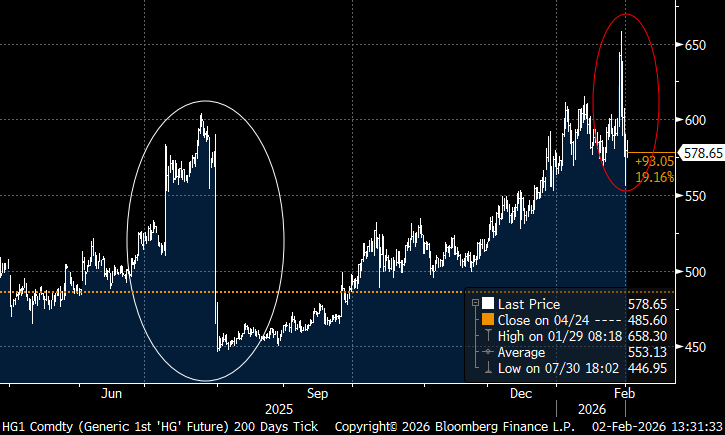
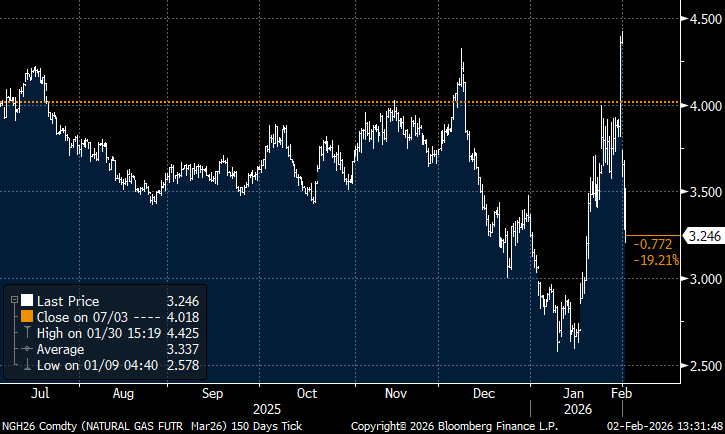
It’s not just gold and silver putting in these historically convex and asymptotic chart patterns. Look at selected charts in the past 18 months of copper, natural gas, and South Korean equities (which doubled in the final 8 months of 2025 and were 20% higher in the month of January alone). I could pull up plenty of FX charts as well that look less “disruptive” but in the FX world are no less chaotic. These are no longer isolated incidents – they are frequent occurrences that are NOT indicative of a stable global financial system. Many will attempt to explain away these events as geopolitical repositioning and very event driven, which in many ways they are. I’m also not suggesting a crash is imminent, because I don’t believe one is imminent. But instability in nature does not resolve itself with stability easily. It won’t here, either.
(FWIW, technically speaking, gold and silver stopped pretty much exactly where they were supposed to.)
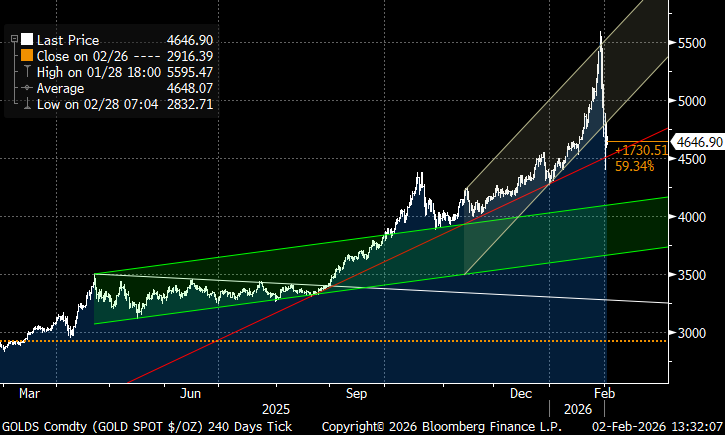
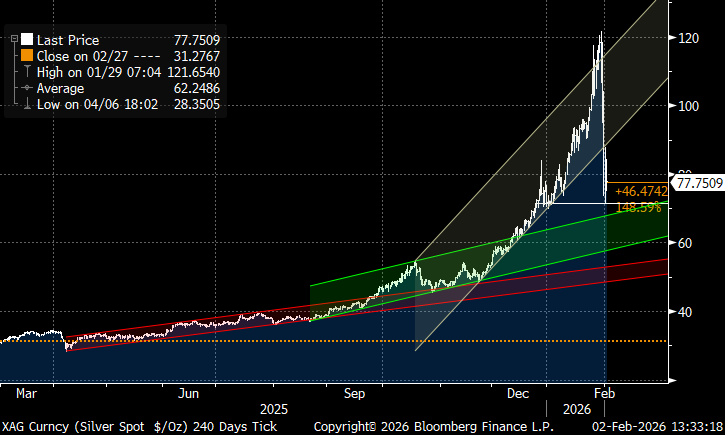
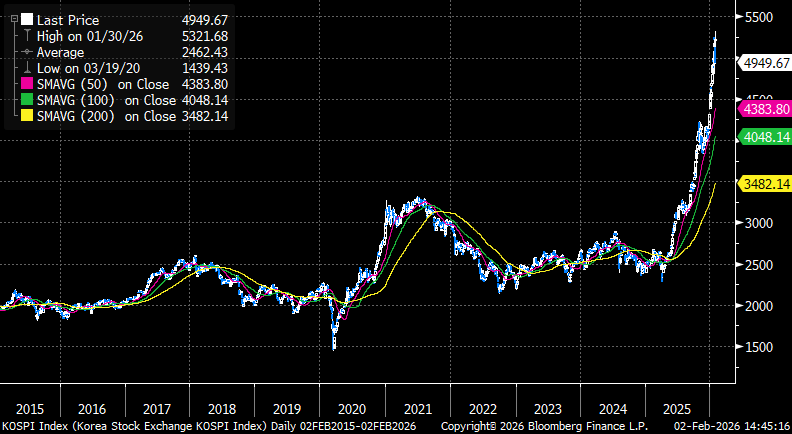
Which brings me to my second theme – my gut tells me the current ~50 year old financial system is finally beginning a great unraveling. Inflation was always likely to be the ultimate undoing because it’s what historically causes the most societal distress. I would argue that those inflationary expectations at the consumer level have become firmly entrenched, regardless of what the FOMC or anyone in politics may so. An increasing portion of the population (majority? vast majority?) are losing faith in the upward mobility benefits and opportunities of the capitalist society that America has benefited from for the better part of its history. The manifests itself in any number of behaviors, one of which is “get rich” opportunities (like 0DTEs). It also is evident in how people/investors are losing faith in paper assets increasingly and shifting focus to hard assets, it just becomes a matter of which one they want to be in at any given point in time. It seemed like BTC was the first “hard asset” to diversify into, until the afternoon liquidation last October 10th removed a level of confidence that has been impossible so far to replenish. The calendar flipped to 2026, and we saw the shift to gold and silver and nuclear and rare earths. Time will tell what Friday’s liquidation event in silver, which was down nearly 40% in one day, will do to confidence in those hard assets, but given the need for silver and rare earths for next generation technology, I’m more inclined to believe those ATHs will be revisited eventually.
Sidebar: do you realize how ludicrous it is to write that last sentence? Spot silver, a mainstream tradeable asset of wealth in many societies and value in the industrial production chain, traded at both $118.xx and $74.xx in one 24 hour period. And yet on Monday, one business day removed from that carnage, the S&P 500 closed 2 points below it’s closing day all-time high.
The ultimate problem with this mentality is that eventually these are all inflationary (over time) and incredibly destabilizing. Industrial production can’t budget and cost plan, let alone function with any modicum of stability, if these input costs are vacillating so wildly in an upward fashion. What CFO with silver raw material costs was budgeting for $100/ounce 12 months ago when it was in the $30s? Copper at $600 when it was in the $400s? Those costs have to be passed on to the end user (i.e. inflation), absorbed by the middleman (i.e. margin compression), and/or projects get cancelled (i.e. decreased revenue projections). If you are a natural resource rich society that is benefiting more from the increased revenue from mining and producing then these three dynamics, your economy and society can net benefit. The USA is not one of those such societies. Not even close. As such, all three dynamics are ultimately negative for the economy and equities. Once enough time passes and these three potential outcomes are incorporated into economic data, earnings results, and forecasts, equities adjust, investor and consumer confidence is spooked into recessionary pressures and inflation stops. Then monetary and/or fiscal stimulus steps in and the cycle starts all over again – except there’s no dry powder left for either.
That’s how this is going to play out in the coming months. I just don’t see another way around it, unfortunately. What happens after that… we can worry about another day.
Here are my Top 4 themes for the balance of 2026
- Midterm elections – affordability vs. sustainability
- Energy production/infrastructure
- AI – hardware vs. software, China vs. US
- Corporate margins vs. consumer health
1. Affordability vs. Sustainability – the politicization of the 2026 Midterm elections
“Affordability” has now become the buzzword as we begin the runup to the midterm elections, predominantly because of the polling data. As I’ve highlighted for many months, inflation has completely eroded the vast majority of US household wealth such that excess cash buffers are reaching historical lows. Wage growth has not – and will not – outpace this bout of inflation, regardless of what the statistics may suggest, because anyone with a paycheck can do the math and compare their change in wages to changes in housing, insurance, healthcare, food, and energy costs over the past 5 years. John Mauldin published a nice piece on affordability over the weekend (here). It is not a fair fight.
As it relates to asset markets, affordability most directly affects the previously mentioned categories:
- energy, particularly gas prices and utility bills
- healthcare, notably insurance premiums and prescription drugs
- food, both grocery stores and restaurants
- housing
In the past 60 days, we’ve seen a rabid and rapid attempt to attack all areas by the administration, which I expect will continue into the summer:
- Healthcare – look for some version of ACA reform to pass even though many Republicans are against it, because if they don’t, their re-election prospects will look dimmer than they already do. Also watch for continued attacks on prescription drug prices and the PBMs.
- Energy – I’ll touch on AI infrastructure strain in the next section, but needless to say, utility bills and gas prices are going to be talking points going forward. Is it any coincidence that the administration is being enormously aggressive in Venezuela, Greenland, and Iran to begin 2026? I don’t think so. Securing “cheap” forms of energy and natural resources to combat the threat of China may be the sound bit and longer-term perspective, but I believe keeping energy costs and resources controlled for future elections has equivalent priority.
- Housing – mortgage rates will get all the focus, and the idea of mortgage portability sounds great, but I’m curious if we’ll see an introduction of floating rate mortgages tied to Fed Funds, which can thus be directly influenced by a “partisan” Federal Reserve Chairman if enough of a majority on the FOMC exists… Cut FF by 100bps, create mortgages tied to that, and let’s see how housing market responds. Not saying it’s coming, but I’m watching for it.
2. Energy production/infrastructure
- AI infrastructure sounds great and will show well for GDP growth, but the amount of energy data centers consume is astounding. According to analysis conducted by the Bismarck Brief (here), there are nearly 16 Gigawatts worth of data center projects to be finalized in the next 2 years. How much power is that? 1 Gigawatt can power 750,000-1,000,000 homes. 16 Gigawatts is effectively the housing population of Los Angeles MSA. So… how in the world do we create 16 GW of “new” energy in the bureaucratic world we currently operate in without creating enormous pricing pressures on households, on top of the ongoing grid maintenance required by our relatively antiquated energy grid? As best I can tell, alternative energy has been the best performing subsector in the first month of 2026 – look at Uranium-related stocks as an example. Will that continue? How can it?
- AI infrastructure is creating almost asymmetric strain on energy grids and providers. Solar and wind can only do so much because data centers need constant power to cool their data towers, so invariably coal, nuclear, and natural gas should pick up the slack.
- This is going to be an incredibly volatile trade thesis from both sides throughout the year. I expect to be very attuned to both sides to it, especially since I’ve benefited greatly from the long side to start 2026.
3. AI – hardware vs. software, China vs. US
- This is in many ways top of mind for everyone because of how much MAG7 and SPX/NDX is dictated by AI spending and growth. How the market trades from a sentiment perspective will be dictated in many ways by this.
- To me the theme is less about revenue growth meeting expectations and more about which solution ends up “winning” – the US system, dominated by MAG7 software/hardware forming a pseudo-oligopoly, or China’s more open system with much less oligopolistic control and seemingly less proprietary software. Remember the Deepseek scare ~1 year ago that wiped out 15+% of NVDA’s market cap in 1 trading session? That might not happen again, but the repercussions of China’s system “winning” versus the US – even if it’s a modest victory – changes the math materially around so many inputs into asset prices.
- I’m fairly certain this is not resolved in 2026, but I’m also fairly certain we will be closer to an answer by the end of the year.
- Again, this is something I’ve harped on ad nauseum the past few years. Eventually a US consumer that has very little spending power cannot keep pace with expectations of spending. All of the data suggests the US consumer is very close to being tapped out (e.g. consumer credit, real wage growth stagnation, enormous increase in flex pay spending arrangements) and many of the major banks have highlighted this dynamic in recent earnings calls. A great update from Craig Shapiro a few months ago is here.
- Corporate profitability and free cash flow have been incredible the past handful of years, not incoincidentally a result of the massive and never-ending fiscal stimulus that continues to transfer “wealth” from the public to private sector. Corporate profit margins currently remain at/near all-time highs, but so do expectations of continued corporate profitability health, revenue growth, AND multiple expansion.
- I cannot help but wonder how the extraordinary increase in input costs over the past 12 months, coupled with the likely inability to pass all of those cost increases on to end buyers, impacts profit margins and earnings forecasts in 2026. Labor costs may not be rising, but everything else that I already highlighted is – commodities, energy, healthcare, etc.
- Price/earnings ratios remain historically elevated and simply cannot provide the buffer for guidance disappointment in 2026.