I have been bullish on gold for quite some time now (most recent examples here and here), but the recent asymptotic price action has shifted my emotions around gold from simple bullishness to extreme concern.
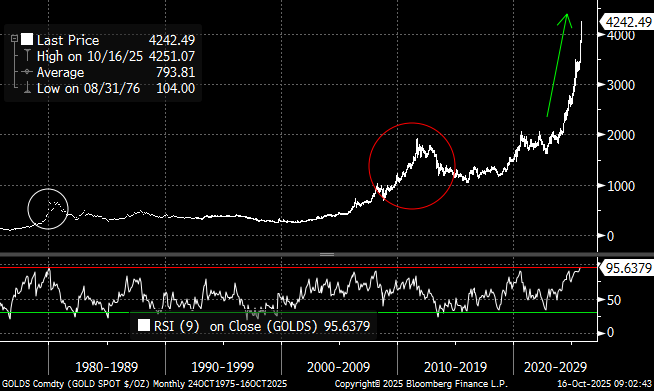
Since the Nixon administration elected to leave the gold standard ~50 years ago to fund the Vietnam conflict, gold is currently behaving in a manner we have only seen 2 other times: late 1970s/early 1980s and early 2010s.
The first period saw extraordinary stagflationary price pressures, predominantly due to the oil shortages surrounding Iran Contra. Gold tripled in ~2 years during those incredibly uncertain times, peaking in the summer of 1980 and leading to the election of Ronald Reagan. When Paul Volcker raised the Fed Funds rate north of 15%, his stated objective was to wipe out inflation and set in motion a path toward financial stability (and ultimately the peak of US monetary hegemony). Gold responded in kind, dropping ~50% in 2 years as financial stability returned and economy prosperity ignited.
The second period emerged in the aftermath of the 2008/2009 deflationary shocks, when the Ben Bernanke-led FOMC decided deflation needed to be avoided at all costs and launched multiple iterations of QE in an attempt to actually create inflation. The massive influx of liquidity found its way into precious metals initially, with investors expecting to see significant inflationary pressures emerge from the unprecedented monetary policy actions. Gold nearly tripled in the ~3 years from the fall of 2008 to the summer of 2011. Inflation barely emerged, however, as the global economy simply did not have the proper supply and demand imbalances required to create sustainable inflationary pressures. The geopolitical threat that was/is China wasn’t concerning yet, the EU was a disaster during the sovereign debt debacle, and the US consumer wasn’t emotionally and financially healed post the 2008 asset shocks. Without sustainable inflation, precious metals dropped ~50% over the next 4 years as capital rotated back into equities and the broader economy.
To more succinctly summarize the prior two gold manias in modern monetary history… the first period was driven by stagflationary pressures, predominantly caused by outside geopolitical forces, eventually tampered down by aggressive monetary action; the second period was driven by an expectation that inflationary pressures would emerge from previously unprecedented monetary action, but never did.
How do we explain the move now? The answer is different, but far more perilous.
Gold is exploding now based on both an expectation and assumption that the current deficit spending system is both unsustainable and unstable, and yet it will continue because it has to. TINA – There Is No Alternative.
In the US, we are living in a K-shaped economy that increasingly bifurcates the haves (predominantly wealthy, stock owners, and/or baby boomers) and the have nots (everyone else). Since COVID, the Federal government has decided that 5-10% annual budget deficits are the new normal and the country will simply print money to finance those deficits until something breaks. Inflationary pressures that were already emerging in an increasingly deglobalizing climate (which I have talked about ad nauseum) have now solidified, and to paraphrase the late Dennis Gartman, we are forever seeing “inflation in the things we need, less so in the things we want.” The average US consumer no longer is surprised by inflation, simply angered and frustrated by the degree to which it occurs. The unfortunate part about that dynamic is one that history teaches us over and over: once inflation is unleashed, it is almost impossible to eliminate without the emergence of significant hardship first. The forthcoming period in US history will be no exception.
Technically speaking, what gold has done in the past ~60 days is what I surmised it would do in my August update – it released months of stored energy from the sideways action throughout much of the spring and summer by going straight up. I hypothesized that rally would be 7-10% higher at least. HOWEVER, the rapidity, steepness, and extent of that price appreciation is the most unnerving part. Gold has doubled in ~18 months. In the past 60 days, it is up an astonishing 27%, nearly $1000. Gold’s monthly RSI reading is above 95 (calculated on a 9 month trailing basis). That rarely happens in ANY asset, let alone one that is inarguably the greatest indicator of global financial stress.
Moreover, the rampant speculation that is occurring alongside gold, particularly in small companies with no current earnings but merely a focus on AI or blockchain, is increasingly unprecedented, well beyond the 1999-2000 speculative bubble. The “how” is the easy part, as I have also highlighted consistently: market structure evolved over the past few years to favor leveraged ETF and option speculation on a very short-term basis. The advent of 0DTEs, weekly options chains on stocks, and 2x/3x leveraged ETFs on single name stocks has now created the largest speculative investor class ever. This is not a hyperbolic statement, as underlying volumes in daily options and leveraged ETF activity are consistently creating a “this has never happened before” environment. Earlier this week, an ETF manager applied for approval to list 5x (!!) leveraged ETFs on a handful of indices, as well as individual stocks.
If you’re a part of the “have” society, the past 6 months have probably been pretty good to you. If you’re not, it hasn’t – just look at the collapse in subprime auto, credit card utilization rates, and other consumer asset delinquency data as evidence. Throughout the week, a number of regional and large banks have provided corroborating guidance on the status of the US consumer and asset quality in conjunction with their Q3 earnings releases.
The markets will continue to stay afloat as long as the flow of liquidity continues. Since the April collapse, the flow of global liquidity has been increasing at ~10% per annum on a three-month trailing basis (per Michael Howell and his outstanding Capital Wars publications). Absolute liquidity is important, but the flow of liquidity is most important, because as US federal debt increases unabated, the flow of liquidity has to match or exceed the pace to keep the game going. Bessent understands that, which is why Treasury is funding an increasingly larger percentage of the deficit in the front end (both cheaper and where much more liquidity sits) than out the curve. Eventually that won’t be enough, so we’ll see both a reverse of FOMC QT (JPow hinted at that earlier this week) and more monetization from outside parties (IMO those will be both stablecoins and a loosening of SIFI bank liquidity rules). That’s likely coming soon, simply because it has to.
When all is said and done, though, that liquidity dynamic can only last so long before the inevitable forces of the global economy win out. We saw that briefly last Friday, when fears of an escalatory trade spat between China and the US reignited and the NASDAQ 100 dropped ~1000 points on an intraday basis. Did the flow of liquidity just stop? Of course not – but the excessive leverage, historically excessive optimism, and current market structure all colluded to create the dynamics in place for such a drop. We’ll see far more grandiose versions of Friday in the coming months because the liquidity, economic, and emotional cycles are all very mature. All of the warning signs are there, just like they were throughout much of 2007 and early 2008, but history ultimately takes time to play out.
Throughout 2007 and early 2008, when I was a young pup sitting on the fixed income trading floor, I remember talking about bank failures with colleagues who had been in the business longer than I had been alive. One colleague’s words still ring in my head: “When liquidity problems stem from solvency concerns, you can always raise capital to alleviate the liquidity problems. When solvency concerns become liquidity problems, the game is over.” That comment was prescient, as our employer ended up being one of those banks that ended up having a liquidity concern, precisely because the market believed it had too large of a solvency concern. And the game did end for that bank.
The US doesn’t have a liquidity concern yet, but the behavior in the gold market is telling us there are increasing solvency concerns. When the USA starts having liquidity concerns – and that increasingly is starting to feel like a when, not an if – that’s when this version of the game will be over.
Away from gold, the messages are equally conflicting:
- WTI broke down below the $60 psychological level and remains firmly bearish. Maybe the uncertainty regarding tariffs is creating undue global economic pressure after all? The global energy market certainly supports that thesis. If we’re not going to get underlying economic strength and activity, which energy is insinuating, how can risk assets continue to rally?
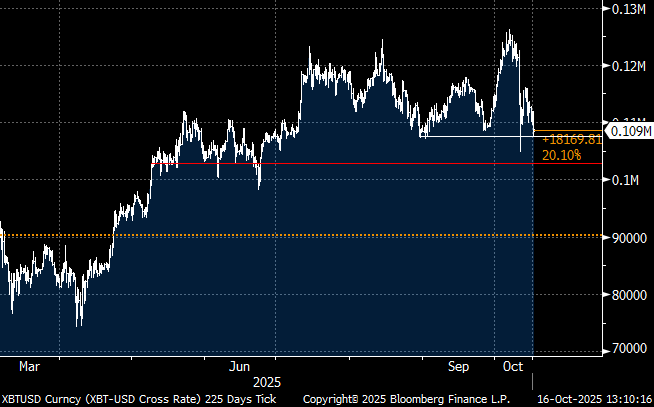
- Crypto has been under significant pressure of late, notably the leveraged liquidation last Friday afternoon. While I think we need to test lower, BTC should start to look attractive closer to $105k, maybe even as low as $100k, especially once we see more liquidity coming from the FOMC/Treasury.
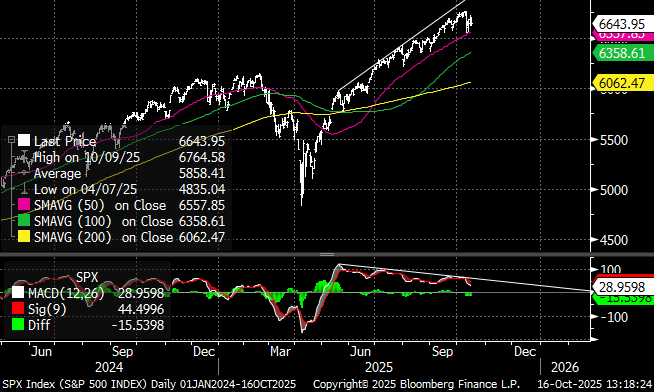
- Technically, equities are fine for the moment, but everything looks very tired. S&P 500 keeps making higher daily price highs on lower indications of strength, which is always a sign that the underlying move is very mature. Many bulls would almost prefer a back test of the 20 week moving average (green line) or 200 day moving average (yellow) in the next few weeks to generate some energy for a push higher into year end / Q1 2026.
- Remember, equities remain historically unparalleled with regard to valuations and are really only sustaining themselves with the help of the AI frenzy and the massive amounts of liquidity from both the US fiscal and global monetary authorities. Eventually that will matter.