America has a major problem – as a society, we simply no longer have the desire, nor ability, to control fiscal spending and return to a somewhat balanced way of life.
Our spending problem cannot be fixed by a combination of growth, interest rate cuts, and/or tax increases. The math doesn’t work.
Spending cuts requires a dedication and desire we simply do not have.
On top of that, the longer-term cyclical seeds for the inflationary environment of today were sown long before COVID – the fiscal response to COVID simply ignited the brush that was ready and waiting to burn.
We currently live in a fiscal dominant era of deglobalization, a new global tariff system harkening back to the 1920s, high nominal interest rates (compared to the previous 30 years), rising defaults/delinquencies, historically unprecedented economic class disparity, and an overreliance on equity market returns to drive our economy’s overreliance on consumer spending.
The current trajectory toward a seemingly less independent FOMC is also one of the largest challenges to the current global monetary regime, as the FOMC has not been so publicly and politically assaulted since LBJ physically confronted William McChesney Martin in 1965. Make no mistake – while monetization by the FOMC of our economy and financial markets began in 2008, a step that arguably should never have been taken, the politicization of the FOMC is far more dangerous to the global economy and financial system.
The proverbial accelerant on the fire is the change in market structure – the advent of 0DTE options, 2x/3x levered ETFs, higher velocity algorithmic vehicles, and quant strategies have increased both the frequency of enormous market moves (e.g. last Thursday/Friday’s 200 point drop in the S&P 500) as well as the velocity of those moves.
Without being hyperbolic, I personally believe there has NEVER been a time in modern history when there has been such significant uncertainty in the forthcoming 5 years about nearly every single asset class – equities, interest rates, commodities, crypto, foreign exchange, real estate, private credit, etc.
Everything.
But Rome wasn’t built in a day, and markets aren’t going to implode.
The reason? Liquidity.
Michael Howell at Capital Wars provides regular insight into global liquidity available to the markets, looking at a combination of factors, including but not limited to, actual global central bank monetary injections, volatility, FX, and equity prices.

It’s basically straight up since the inauguration. And for those of us who have been in the markets since 2008, we all know that central bank liquidity always finds a home in the markets first.
Sure, the economy is fine – by most measures, the labor market is at or near full employment, tax policy is a certainty in 2026, business spending plans for the future, at a minimum, should unfreeze given the relative certainty now on tariffs, and the equity rally continues to provide a tailwind for consumer spending.
And as long as liquidity continues to be pumped into the markets – and there’s absolutely no reason to believe otherwise – I’m still expecting higher highs in equity indices before the end of the year, potentially much higher if we get a bit of a NASDAQ 2000 blowoff top feeling.
I strongly believe there are still meaningful moves to be made in commodities, both precious metals and industrial, and crypto, though that’s an asset class I’m far more reticent to predict.
The bubble being blown here feels far more material than anything we’ve ever witnessed before. It can run higher and longer than anyone can believe, but when it ends, no one wants to be left holding the bag. So as this unfolds further in the fall and potentially early 2026, I’ll be the one screaming from the sidelines… Boy who cried wolf? Maybe. Maybe not. Remember my 2025 Outlook? I called for SPX 6500+…
I’m watching three things as we move into the fall:
- What does Powell talk about at Jackson Hole, and what is the response from both the President and the markets to that speech?
- Can Nvidia continue to exceed expectations and carry the markets higher? For context, it has more than doubled off its April lows, which is somewhat hard to believe considering it’s a $4.3+ trillion market cap stock with a forward PE of 41.
- What do China and the US ultimately agree to on tariffs? They’re the lone remaining holdout at the moment, at least the most relevant one.
A few charts to consider:
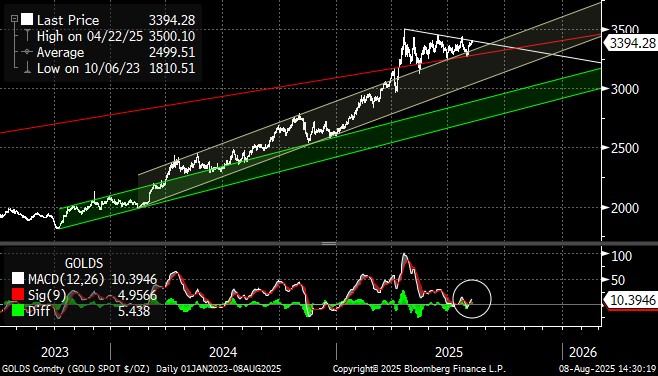
- Nothing is bearish about gold. Nothing. Presuming this ~4 month triangle pattern resolves to the upside, there’s easily another 7-10% higher in gold in the relative near term, let alone longer term. Just like I said months ago, BTFD.
- The term UST market seems relatively uninvestable, honestly, which is a term I won’t use lightly considering I spent the vast majority of my career in fixed income. It seems increasingly likely that the executive branch and FOMC are going to do everything they can to keep the long end of the yield curve from running wild, whether by “stealth” QE or further reconstitution of quarterly funding plans into short-dated bills/notes. Economic data simply seems increasingly less influential in that market, I’ll continue to look for clues elsewhere.
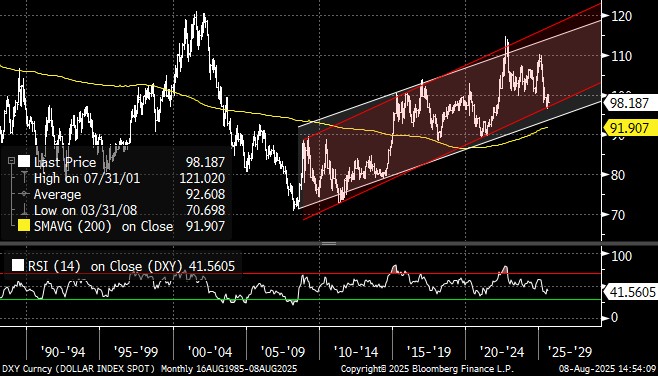
- In most cases, I would think the USD would be a screaming buy “here” as long as these lows hold. That still may very well be the case, but the longer-term damage being done to the USD as a financial hegemon is keeping me more cautious than usual.
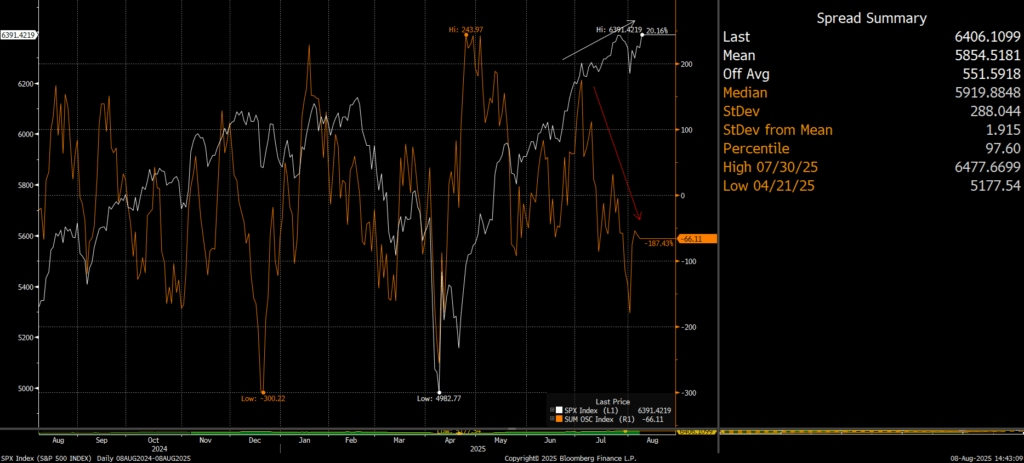
- Breadth in the broader market is TERRIBLE considering we’re sitting at record highs in SPX and NDX. The McClellan Oscillator (see here McClellan Financial Publications) continues to make lower highs on each successive push higher in price, culminating with a closing all-time weekly high on the S&P 500 with an Oscillator reading below 0. Megatech and oligopolies are running this market higher, this is all the proof you need.
I am a student of history, across economics, politics, and human history, and the confluence of everything that we are seeing now does not often occur once in a generation – it often occurs only once in a human lifetime.
And I feel it’s my obligation to see the other side, as unlikely as that may be.